Engineering Resilience: The Technical Guide to Hot-Dip Galvanized Gabion Systems in Modern Civil Infrastructure
In geotechnical engineering and erosion mitigation, structural failure rarely stems from a lack of mass; it stems from material degradation under environmental stress. For earth retention and riverbank stabilization, specifying a hot-dip galvanized gabion provides a balanced compromise between structural ductility, hydraulic permeability, and long-term corrosion resistance.
Unlike rigid concrete retaining walls, which are prone to cracking under differential settlement, galvanized wire-mesh gabions form a flexible, monolithic gravity mass that consolidates over time. However, achieving an intended 30- to 50-year design life demands strict compliance with metallurgical coating standards, automated wire weaving protocols, and rigorous on-site installation practices.
Technical Foundations: Metallurgy and International Standards
A hot-dip galvanized gabion consists of a double-twisted hexagonal wire mesh (typically 8×10 cm or 6×8 cm aperture) or welded wire mesh assembled into compartmentalized rectangular baskets, filled on-site with clean, non-degradable rock.
The protective integrity of the system relies entirely on the metallurgical bond between the low-carbon steel core and the sacrificial zinc layer.
Governing International Standards
-
ASTM A975: Standard Specification for Double-Twisted Hexagonal Mesh Gabions and Revet Mattresses. Sets baseline requirements for wire diameters, lacing operations, and mechanical pull tests.
-
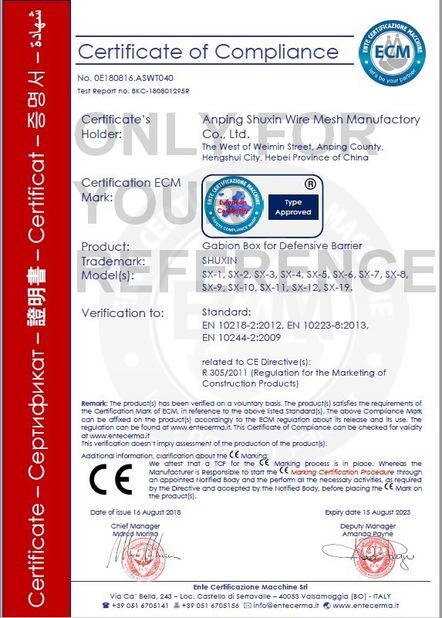
BS EN 10244-2 (Class A): Defines zinc coating weights. For standard 2.7 mm to 3.0 mm mesh wire, minimum zinc density must reach 245 g/m² to 275 g/m² to prevent rapid passivation failure.
-
BS EN 10223-3: Specifies the geometric tolerance and minimum 2.5 turns for the double-twist weave, preventing unravelling under point tensile loads.
Manufacturing Process and Quality Assurance
Producing a high-spec hot-dip galvanized gabion involves thermal wire treatment, continuous hot-dip immersion, precision automated weaving, and destructive bench testing.
Wire Drawing and Hot-Dip Galvanization
The process begins with low-carbon steel wire rods (SAE 1006 / 1008).
Cold drawing process: The steel wire undergoes cold drawing through a series of hard alloy molds to achieve the precise target diameter (typically 2.7 mm for mesh wire, 3.4 mm for edge boundary wire, and 2.2 mm for binding wire), while maintaining the tensile strength between 350 N/mm² and 500 N/mm².
Surface treatment: The drawn steel wire is continuously passed through an acidic immersion plating tank to remove iron oxides, and then enters a ammonium chloride fluxing tank to prevent oxidation reactions before immersion.
Zinc immersion plating: The steel wire passes through a molten zinc liquid tank at a temperature of approximately 450°C (842°F). During this process, an iron-zinc alloy layer (including γ, δ and ζ phases) is formed, and an outer layer of highly ductile pure zinc (η phase) is covered. Nitrogen wiping of the mold is used to measure the output steel wire and ensure the consistency of the circumferential coating thickness.
Weaving and Fabrication
In the weaving workshop, the heavy automated loom frames interweave parallel steel wires through a continuous 720-degree double twisting process.
-
Double-Twist Geometry: The double-twist mechanism ensures that if a single strand is severed during rock-dropping operations, structural unraveling remains arrested within that specific hexagonal cell.
-
Selvedge Mechanics: The raw mesh cut-ends are wrapped securely around heavier perimeter border wires (selvedge wire). In high-volume production lines, automated wrapping machines loop the mesh wire around the selvedge core through a minimum of 2.5 turns, avoiding localized pull-out during structural flexure.
-
Diaphragms and Packaging: Internal partitions (diaphragms) are secured at 1-meter intervals along the length to control rock migration. Baskets are folded flat and hydraulically bundled into shipping units.
| Test Parameter |
Standard Benchmark |
Inspection Methodology |
| Tensile Strength |
350 - 500 N/mm2 |
Universal Testing Machine (UTM) axial pull |
| Zinc Coating Mass |
> 245 g/m2 (for 2.7mm wire) |
Gravimetric Stripping Method (ASTM A90) |
| Coating Adherence |
No peeling/flaking under finger friction |
Wrapping wire around a mandrel (4X wire diameter) |
| Mesh Pull Resistance |
> 35 kN/m transversetension |
Clamped section tensile frame |
Field Implementation and Assembly Operations
Even fully certified materials can fail prematurely if field assembly ignores basic geotechnical rules.
Installation Best Practices
-
Foundation Prep: Excavate the foundation bench down to competent stratum. Compact subgrade to at least 95% Standard Proctor density. Lay a non-woven needle-punched geotextile (minimum 200 g/m²) behind and beneath the basket footprint to prevent subgrade piping while allowing water to pass through.
-
Erection: Open folded units on hard, flat ground. Pull up side, end, and diaphragm panels vertically. Secure all vertical edges using high-tensile galvanized C-rings (Pneu-Nail type) at nominal 100 mm to 150 mm centers, or with a continuous spiral lacing wire alternating single and double loops through each mesh cell.
-
Stone Filling:
-
Use hard, durable rock (basalt, granite, or dense limestone) with particle sizes between 100 mm and 200 mm. Avoid rocks that disintegrate easily under freeze-thaw cycles or high-calcium chalks.
-
Fill the structure in three equal lifts (approx. 330 mm each for a 1-meter-deep unit).
-
Internal Bracing: At each one-third stage, install cross-tie bracing wires connecting the front and rear face panels. This stops the front face from bulging outward under stone pressure.
-
Flat, smooth rocks should be placed by hand against exposed faces to minimize void volume and create a clean, uniform wall face.
Field Applications and Engineering Trade-Offs
Primary Application Scenarios
-
Riverine Scour Protection: Unlike impermeable sheet piles, permeable stone mattresses dissipate hydraulic kinetic energy while preserving groundwater continuity. Over time, interstitial voids fill with silt, letting native roots lock the stone matrix in place.
-
Highway Slope Retaining: For cut slopes along transportation corridors, tiered gabion units tolerate slight ground movements without shearing.
-
Culvert Wing Walls and Energy Dissipators: Durable ballast containment stands up to torrential debris flows better than unreinforced shotcrete.
Technical Limitations and Maintenance Realities
While standard galvanizing resists atmospheric corrosion well, design engineers must avoid applying plain galvanized units across all conditions indiscriminately:
-
Acidic and Saline Vulnerability: If soil or water pH drops below 6.0 or climbs above 9.0, or in coastal zones with high chloride concentrations, zinc oxidizes quickly. For marine or low-pH situations, specify a dual-coating system: hot-dip zinc plus an extruded PVC or polyamide outer sheath.
-
Bedload Abrasion: Fast mountain streams carrying sand and gravel can wear through pure zinc coatings on bottom revet mattresses. In those beds, install thicker wire gauges (3.0 mm or heavier) or lay concrete caps over wear points.
-
Routine Inspection: Inspect structures annually after major flood stages. Check for severed wire loops, front-face stone settling, and perimeter geotextile clogging. Repair cut strands immediately using 2.2 mm galvanized tie wire to keep the stone confined.
Frequently Asked Questions (FAQ)
What distinguishes a hot-dip galvanized gabion from an electro-galvanized alternative?
Electro-galvanizing (cold galvanizing) applies zinc via electrodeposition, yielding a thin coating of only 10 to 40 g/m². This layer quickly breaks down outdoors, often rusting within 12 to 24 months. In contrast, hot-dip galvanizing forms true metallurgical iron-zinc alloy layers with a heavy zinc shell of 245 to 290 g/m², providing sacrificial protection that can last decades in neutral soils.
Can recycled or demolition concrete be used as stone fill?
Crushed clean structural concrete can be used if it passes test requirements for soundness, compressive strength, and size grading (100 mm to 200 mm). Avoid low-density building rubbles, porous cinder blocks, and concrete with exposed rebar ends, as exposed steel can cause galvanic corrosion where it contacts the mesh wire.
How does the double-twisted weave prevent unraveling?
The double-twist weave interlocks adjacent wire pairs through two full turns (720 degrees). Under localized shear failure—such as a direct hit from heavy drift debris—tensile stresses transfer across surrounding cells. This holds the wire in place and keeps the tear from running, unlike simple chain-link designs that pull apart under local line breaks.


 Uw bericht moet tussen de 20-3.000 tekens bevatten!