logo
Meer producten
INLEIDING VAN HET BEDRIJF

Hebei KN Wire Mesh Co., Ltd.

Hebei KN Wire Mesh Co., Ltd, werd opgericht in 2013, is een professionele fabrikant die zich bezighoudt met het onderzoek, de ontwikkeling, de productie, de verkoop en de service van defensieve barrière, gelast Gabion Box,Wave Gabion Basket We zijn gevestigd in Hengshui stad, Anping county met een handige toegang tot transport.Onze ervaren medewerkers zijn altijd beschikbaar om uw eisen te bespreken en volledige klanttevredenheid te garanderen.In de afgelopen jaren heeft ons bedrijf een reeks ...
Bedrijfsnieuws
Laatste bedrijfskennis over Gabion Flexible Retaining Structures: Manufacturing, Installation, and Engineering Applications
2026/08/14
Gabion Flexible Retaining Structures: Manufacturing, Installation, and Engineering Applications Gabion structures—wire mesh baskets filled with stone—are not a recent invention, but their use in hydraulic protection, slope stabilization, and landscape construction continues to expand. The core value of a gabion lies in its ability to combine the self-weight stability of stone fill with the flexibility of a steel mesh container. This allows the structure to absorb differential settlement, relieve hydrostatic pressure, and remain serviceable in conditions where rigid concrete or masonry would crack. Understanding gabion performance begins at the production line. The anti-corrosion quality of the wire and the strength of the mesh joints directly determine how long a gabion will survive in aggressive environments. The following article covers production processes, quality control, installation guidelines, real-world cases, and maintenance recommendations. 1. Core Value and Engineering Logic of Gabion Traditional rigid structures such as mortared stone or cast-in-place concrete retaining walls often develop through-cracks when the foundation settles unevenly. A gabion, by contrast, uses a combination of wire baskets and loose stone fill to distribute loads across the entire structure. The voids between stones make the wall permeable, allowing groundwater to drain freely and reducing the buildup of hydrostatic pressure behind the wall. At the same time, the steel mesh allows limited deflection, giving the structure greater tolerance to soft ground, expansive soils, and freeze-thaw cycles. In engineering practice, gabion systems are commonly used for: Riverbank and channel protection; Road and railway slope stabilization; Rockfall barriers and debris flow diversion; Landscape walls, acoustic barriers, and ecological retaining structures. These applications are only as reliable as the manufacturing controls behind the wire mesh. 2. Gabion Production Process: From Wire to Cage 2.1 Raw Materials and Anti-Corrosion Systems Gabion baskets are typically made from low-carbon steel wire with diameters ranging from 2.2 to 4.0 mm. Common mesh openings include 60×80 mm, 80×100 mm, and 100×120 mm. According to widely referenced standards such as EN 10223-3 and ASTM A975, the tensile strength of wire for gabions is usually controlled between 350 and 550 N/mm². This range provides sufficient mesh strength while retaining the flexibility needed for the structure to deform without breaking. Corrosion protection is the most critical production step. Common systems include:     Anti-Corrosion Type Process Characteristics Suitable Environment Hot-dip galvanizing Zinc coating typically not less than 245 g/m² Freshwater, ordinary soil Galfan (Zn-5%Al-mischmetal) Corrosion resistance roughly 2–3 times that of standard galvanizing River channels, wet environments Hot-dip galvanizing + PVC coating Galvanized layer plus 0.4–0.8 mm PVC coating Chemical attack, marine, polluted soil On the production floor, operators adjust drawing and coating parameters according to wire diameter and coating thickness. For example, PVC-coated wire must pass pinhole testing before weaving. If pinholes are present, localized corrosion can spread rapidly even when the underlying zinc layer is intact. 2.2 Mesh Weaving and Welding Technologies Gabion mesh is produced in two main forms: double-twist hexagonal mesh and welded mesh. Double-twist hexagonal mesh is the most widely used type in hydraulic engineering. Machines twist two adjacent wires together for at least three full turns to form a hexagonal opening. The key advantage of this structure is that if one wire is cut, the mesh does not unravel easily like a simple chain-link fabric. During production, operators must adjust the twisting die clearance and wire tension according to the mesh opening. Excessive tension deforms the hexagon and damages the wire surface; insufficient tension produces loose twists and reduces the mesh tensile strength. Experienced operators often judge equipment condition by the metallic friction sound and the uniformity of twist pitch. Welded mesh is more common in landscape walls, architectural facades, and other applications requiring a flatter appearance. Resistance welding fuses the longitudinal and transverse wires at each intersection. The shear strength of each weld must meet specified values. Welded gabion panels are neat and dimensionally accurate, but they are more rigid and less tolerant of differential settlement than double-twist mesh. 2.3 Cage Assembly and Quality Control Standards After the mesh panels are formed, they are cut to size, reinforced with a thicker edge wire, fitted with internal diaphragms, and connected into box shapes using lacing wire or C-rings. The edge wire is usually 0.2–0.5 mm thicker than the mesh wire to improve tear resistance at the edges. Diaphragms prevent stone fill from shifting within the basket due to settlement or hydraulic forces. Quality control typically includes: Coating adhesion test: Wrapping wire around a mandrel of specified diameter and checking for coating flaking; Mesh opening tolerance: Diagonal deviation usually within ±5%; Tensile strength test: Sampling mesh panels to confirm strength meets design requirements; PVC pinhole testing: Conducted on coated wire rolls, either continuously or by sampling. Common defects include mechanical scratches on the galvanized layer, weak welds, cracked PVC coating, and uneven twist pitch. If these defects are not identified before shipment, they can be amplified during transport and stone filling. 3. Practical Application Scenarios 3.1 Hydraulic Revetment and River Training This is the most typical application for gabion structures. Riverbank protection must withstand continuous flow scour, water level fluctuations, and slope movement. Because the baskets are permeable, groundwater behind the wall can drain freely, greatly reducing the hydraulic pressure acting on the structure. The voids between stones also provide attachment surfaces for aquatic plants and microorganisms, supporting ecological recovery. In river training projects, gabions are often combined with geotextile filters and gravel bedding layers. The geotextile prevents the loss of fine soil particles, the gravel layer provides a level foundation, and the gabion system serves as the surface protection layer. 3.2 Road Slopes and Retaining Walls In road construction, gabion retaining walls are used for embankments, cut slopes, and bridge abutment wing walls. Compared with concrete retaining walls, gabions do not require closely spaced expansion joints, heavy formwork, or extensive curing. For mountainous sites with limited access, stone fill can often be sourced locally, and the folded baskets are easy to transport, allowing faster construction. 3.3 Landscape Architecture and Ecological Restoration In recent years, gabions have entered landscape design. Fill materials are no longer limited to quarried stone; designers also use pebbles, recycled brick, recycled concrete, glass aggregate, and even timber. The texture of the wire mesh contrasts with the fill material, making gabions suitable for feature walls, planters, benches, and sign foundations. However, landscape gabions require careful handling of exposed wire ends to prevent injury. 4. Installation Guide and Real-World Case Study 4.1 Standardized Construction Steps Foundation preparation: Remove loose soil and soft layers. If necessary, install a gravel bedding layer or geotextile. Basket placement and connection: Unfold the collapsed gabion, place it in position, and connect adjacent baskets by lacing the edge wires. Stone filling: Fill stone should generally be 100–250 mm in diameter and at least 1.5–2 times the smaller mesh dimension. Fill from the perimeter toward the center to avoid local bulging. At every one-third of the basket height, install tie wires to prevent the face from bulging outward. Lid closure: After filling, fold the lid over and lace it to the basket edges. Lacing intervals should generally be 200–300 mm. Alignment and adjustment: Use a wooden or rubber mallet to adjust the mesh face. Do not strike galvanized wire directly with a steel hammer. Field experience matters during filling. When stone size is too large or filling is too fast, the mesh face visibly bulges under tension. At that point, operators must stop and rearrange the stones. A properly filled gabion should have a slightly taut mesh face, not one stretched to its limit. 4.2 Case Study: Revetment Repair of a River in Southern China In a river training project in southern China, the original mortared stone revetment had cracked in multiple locations due to differential settlement, and some sections had collapsed. The design team replaced the failed sections with gabion revetment over a total length of about 2.5 km. The baskets measured 2 m × 1 m × 0.5 m with 80×100 mm mesh openings. The wire used Galfan coating, and the fill was locally sourced river cobble ranging from 100 to 200 mm. After two flood seasons, including one event close to a 50-year return period, site monitoring showed localized foundation settlement of about 5 cm. However, the gabion structure did not develop through-cracks, and only a few baskets required additional stone fill. Compared with the original rigid design, the gabion solution eliminated the need for closely spaced expansion joints and reduced construction time by approximately 30%. This project demonstrates that under soft foundation and scour conditions, the flexibility of gabion structures can significantly lower long-term maintenance risk. 5. Advantages, Limitations, and Maintenance Recommendations Objectively, gabion systems are not suitable for every situation. Their advantages include: High permeability, reducing hydrostatic pressure; Flexible structure that tolerates differential settlement; Simple installation and use of locally available stone; Ecological benefits, with voids supporting vegetation; Good durability—hot-dip galvanizing or Galfan with PVC coating can last over 50 years in ordinary environments. Their limitations include: Higher corrosion risk in strongly acidic, high-salinity, or chemically aggressive environments; Exposed mesh faces may be damaged by mechanical impact; Stone fill may settle due to vibration or scour, requiring replenishment; Lower impact resistance than monolithic concrete structures. Maintenance recommendations: Inspect the mesh face and lacing wire before and after each flood season; Replenish stone fill when settlement is observed to prevent basket instability; Treat localized scratches in the galvanized layer with zinc-rich repair coatings; In marine or high-salt environments, select Galfan with thick PVC coating and shorten inspection intervals. 6. FAQ: Key Questions About Gabion 1. How long does a gabion structure last? In ordinary freshwater and soil environments, a gabion with hot-dip galvanizing or Galfan coating can last more than 50 years. With additional PVC coating and periodic maintenance, the service life can be extended further. In marine environments, chloride attack accelerates corrosion, so special alloy wire or thick PVC coatings are recommended, with an expected service life of about 20–30 years. 2. How should fill stone be selected? Stone size should be 1.5–2 times the smaller mesh opening, commonly 100–250 mm. The stone should be hard and weather-resistant. Soft shale or weathered rock should be avoided. In freeze-thaw regions, the stone must also meet frost resistance requirements. 3. What are the advantages of gabion walls compared with mortared stone retaining walls? Gabion walls do not require closely spaced expansion joints, have lower foundation bearing requirements, allow faster construction, and provide better drainage. The voids also support vegetation growth. The main disadvantage is the exposed mesh appearance, which may not suit every project style. 4. Which anti-corrosion system is better: galvanizing, Galfan, or PVC coating? Galfan offers roughly 2–3 times the corrosion resistance of standard hot-dip galvanizing and is suitable for wet environments. PVC coating is preferable for chemically aggressive or marine environments but requires protection from mechanical damage during construction and operation. Multiple systems can be combined. 5. Can gabion structures be used in marine environments? Yes, but the corrosion protection grade must be increased. Heavy galvanizing plus thick PVC coating, or special corrosion-resistant alloy wire, is recommended. Inspection intervals should be shorter than in inland environments because chloride ions in seawater accelerate metal corrosion.
Lees verder
Laatste bedrijfskennis over Uitgebreide gids voor scheerdraden: fabricage-excellentie, technische specificaties en toepassingen met hoge veiligheid
2026/08/07
Uitgebreide Gids voor Scheermesdraad: Productie-uitmuntendheid, Technische Specificaties en Toepassingen voor Hoge Beveiliging Het selecteren van de juiste perimeterverdedigingsinfrastructuur vereist een precieze balans tussen fysieke afschrikking, materiaalduurzaamheid en naleving van wereldwijde beveiligingsnormen.Scheermesdraad, ook bekend als prikkeldraad, vertegenwoordigt een van de meest effectieve oplossingen voor beveiligingsomheiningen in militaire, industriële en kritieke infrastructuursectoren. Deze technische gids biedt een volledige analyse van hoe modern scheermesdraad wordt ontworpen, geproduceerd, getest op kwaliteit en ingezet in beveiligingsomgevingen in de praktijk. 1. Scheermesdraad Begrijpen: Bladprofielen en Materiaal Specificaties In tegenstelling tot traditioneel prikkeldraad, dat afhankelijk is van gedraaide draadstrengen met puntige weerhaken, maakt scheermesdraad gebruik van een continue centrale kern van draad, omhuld door een hoogwaardige stalen strip die is gestanst met scherpe bladen. Deze constructie verhoogt de structurele stijfheid en de fysieke dreigingsafschrikking aanzienlijk. Technische Specificaties & Normen Industriële perimeterverdedigingssystemen zijn afhankelijk van gestandaardiseerde bladprofielen die zijn afgestemd op specifieke dreigingsniveaus. Specificatie Parameter Standaard Opties / Bereik Industriële Referentie Diameter Kern Draad 2,5 mm ($pm 0,05 mm$) Hoogwaardig Veerstaal Dikte Blad 0,5 mm ($pm 0,02 mm$) Verzinkt / Roestvrij Staal Treksterkte 1.400 MPa – 1.600 MPa ASTM A764 / EN 10218 Zinklaag (Verzinkt) $120 g/m^2$ – $275 g/m^2$ ASTM A641 / EN 10244-2 Kwaliteiten Roestvrij Staal AISI 304, AISI 316 ASTM A240 Veelvoorkomende Bladtypen BTO-22 (Barbed Tape Obstacle): Met een bladdikte van 22 mm is dit de industriestandaard voor commerciële faciliteiten, onderstations en grensomheiningen. CBT-65 (Concertina Barbed Tape): Ontworpen met een uitgebreid bladprofiel van 65 mm, wat maximale mechanische verstriktingsmogelijkheden biedt voor beveiligde faciliteiten en defensielocaties. 2. Het Productieproces: Van Ruwe Spoel tot Concertina Lussen Het produceren van duurzaam scheermesdraad vereist geautomatiseerde precisietechniek om structurele stabiliteit te garanderen onder zware omgevingsbelastingen.   [Toevoer Ruwe Spoel] → [Precisie Stempelen] → [Koudwalsen Omhulling] → [Concertina Klemmen] → [Verpakking] Stap 1: Precisie Metaal Stempelen Het proces begint met koudgewalste stalen spoelen gemonteerd op geautomatiseerde ontwinders. Hogesnelheid hydraulische persmachines stempelen continue bladprofielen langs de randen van de strip. Het handhaven van nauwkeurige matrijs toleranties tijdens het stempelen voorkomt micro-braam die lokale corrosie kan versnellen. Stap 2: Inbrengen van Hoogwaardige Kern Draad Om te voorkomen dat de scherpe staalstrip uitrekt of breekt, wordt continu een centrale kern van hoogwaardig veerstaal in het midden van de gestempelde strip gevoerd. Stap 3: Koudwalsen Krimpen De gestempelde strip wordt rond de kern draad gewikkeld door een reeks koudwalsmatrijzen. De machine oefent uniforme mechanische druk uit om de buitenrand van de strip stevig rond de kern draad te krimpen, waardoor een solide, onscheidbare eenheid ontstaat. Stap 4: Spoelen en Klemmen Aanbrengen Voor concertina-stijl configuraties wordt de enkele draad op een cilindrische doorn gewikkeld. Geautomatiseerde pneumatische krimptangen installeren zware metalen klemmen op berekende intervallen langs aangrenzende lussen. Wanneer uitgerekt, dwingen deze klemmen de spoel in een stijve driedimensionale spiraalvormige structuur. 3. Kwaliteitsborging en Testnormen Het handhaven van structurele integriteit onder variabele klimatologische omstandigheden vereist rigoureuze laboratorium- en fabrieksvloertests. Tests op Mechanische Integriteit Treksterkte Test: Evalueert de weerstand van de kern draad onder spanning, om ervoor te zorgen dat het product bestand is tegen snijpogingen met standaard handgereedschap. Klem Scherf Test: Verifieert dat concertina klemmen stevig blijven onder mechanische uitzettingsdruk tot aan de ontwerpdrempels. Corrosiebestendigheid Testen Zoutnevel Test (ASTM B117): Monsters ondergaan continue neutrale zoutnevel blootstelling gedurende 480 tot 1.000+ uur om te verifiëren dat zinklagen of roestvrijstalen legeringen roestvorming voorkomen in zones met hoge luchtvochtigheid of kustgebieden. 4. Implementatiestrategieën & Praktische Toepassingen De implementatiemethodologie beïnvloedt direct de verdedigingscapaciteit van een perimeter muur of heklijn. Belangrijke Toepassingsscenario's Grensbeveiliging en Defensie: Meerlaagse concertina-arrays gestapeld in piramideformaties bieden snelle implementatie en formidabele fysieke barrières langs uitgestrekte geografische lijnen. Kritieke Infrastructuur: Onderstations, olieraffinaderijen en waterzuiveringsinstallaties hebben vaak enkele spoel-arrays gemonteerd bovenop ketting- of gaashekken met behulp van V-vormige verlengarmen. Gevangenisfaciliteiten: Hoge dichtheid CBT-65 spoelconfiguraties gestapeld op binnen- en buitenperimeter muren elimineren de mogelijkheid om handvatten te vinden en vertragen doorbraakpogingen. Installatie Best Practices Veiligheidsuitrusting: Technici moeten versterkte leren handschoenen, snijbestendige mouwen en zware oogbescherming dragen tijdens het ontrollen en spannen. Ondersteuning Spanlijn: Voer altijd een zware spanlijn door de bovenste en onderste randen van de concertina lussen om de uitlijning te behouden en doorzakken in de loop van de tijd te voorkomen. Integriteit Klemsteek: Vermijd het te ver uitrekken van concertina spoelen buiten hun ontworpen spiraalafstand; overmatige uitrekking vermindert de totale hoogte van de barrière en verzwakt de fysieke weerstand. 5. Prestatie Afwegingen & Onderhoudsrichtlijnen Voor- en Nadelen Analyse Voordelen: Uitzonderlijke visuele en fysieke afschrikking; hoge structurele sterkte; bestand tegen doorsnijden met standaard tangen; lange operationele levensduur indien correct verzinkt. Beperkingen: Vereist gespecialiseerde hantering en persoonlijke beschermingsmiddelen (PBM) tijdens installatie; potentieel risico op onbedoeld letsel indien verkeerd ingezet in commerciële gebieden met lage beveiliging. Aanbevelingen voor Routinematig Onderhoud Visuele Inspectie Klemmen: Voer halfjaarlijkse controles uit om losse of beschadigde klemmen langs de spoellijn te identificeren. Vegetatiebeheer: Houd klimplanten en boomtakken minimaal 1 meter verwijderd van de lijn om vochtophoping en structurele binding te voorkomen. Corrosie Audits: Inspecteer installaties op grondniveau of aan de kust op tekenen van witte roest op zinklagen of oppervlakteverkleuring op roestvrij staal. Breng onmiddellijk zinkrijk touch-up verf aan op beschadigde zinklagen. 6. Veelgestelde Vragen (FAQ) Wat is het belangrijkste structurele verschil tussen scheermesdraad en traditioneel prikkeldraad? Prikkeldraad bestaat uit twee gedraaide stalen draden met korte, puntige weerhaken op tussenpozen. Daarentegen heeft scheermesdraad een continue stalen strip met scherpe bladen die koud is gekrompen rond een kern van hoogwaardig staaldraad, wat veel hogere weerstand biedt tegen snijden en buigen. Hoe kies ik tussen verzinkt en roestvrij staal scheermesdraad? Standaard thermisch verzinkte opties bieden uitstekende corrosiebestendigheid voor de meeste industriële en commerciële toepassingen in het binnenland. Roestvrij staal (AISI 304 of 316) wordt aanbevolen voor mariene omgevingen, industriële locaties die worden blootgesteld aan agressieve chemische dampen, of locaties die een maximale operationele levensduur zonder onderhoud vereisen. Kunnen concertina spoelen direct bovenop bestaande beveiligingshekken worden geïnstalleerd? Ja. Met behulp van standaard verticale of Y-vormige verlengarmen die aan bestaande hekpalen zijn bevestigd, kunnen spoelen langs de bovenrand worden gemonteerd om de fysieke barrièreprestaties onmiddellijk te verbeteren.
Lees verder
Laatste bedrijfskennis over Defensive Barrier Solutions: Engineering Principles, Manufacturing Excellence en Field Applications
2026/07/31
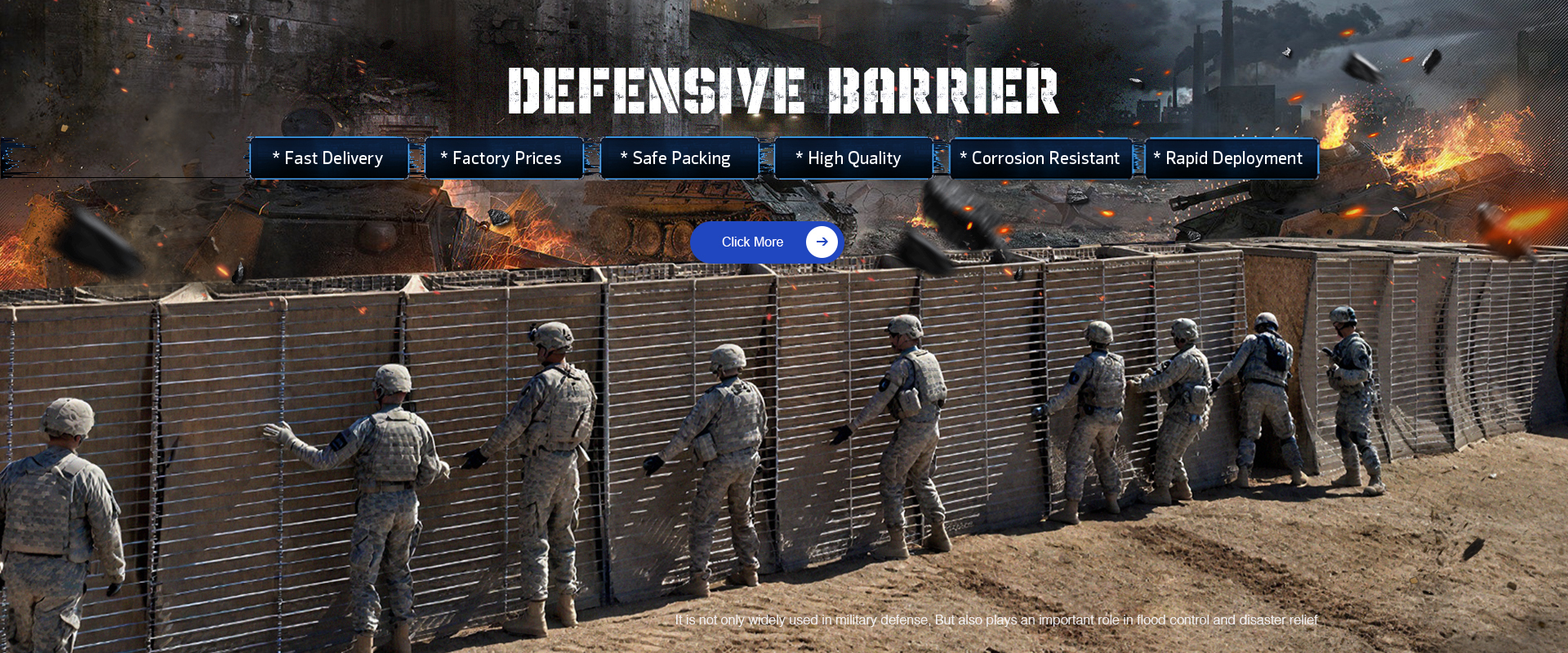
Defensieve Barrière Oplossingen: Technische Principes, Productie-Excellentie en Veldtoepassingen In moderne overstromingsbeheersing, militaire fortificatie en bescherming van civiele infrastructuur, is de defensieve barrière geëvolueerd van tijdelijke zandzakken naar een hoogwaardig, snel inzetbaar bodembeheersingssysteem. Moderne perimeterbeveiliging en overstromingsbescherming zijn sterk afhankelijk van cellulaire opsluitingsstructuren - vaak met draadgaasframes gecombineerd met hoogwaardige non-woven geotextiel voeringen. Deze gids behandelt de materiaalkunde, het productieproces, strategieën voor inzet in de praktijk en de afwegingen die gepaard gaan met defensieve barrièretechnologie. Technische Grondslagen en Materiaalstandaarden Een robuuste defensieve barrière werkt volgens een eenvoudig structureel principe: het opsluiten van cohesieloos vulmateriaal (zoals zand, grind of lokale grond) binnen een flexibele geotextiel cel om een zware zwaartekrachtmuur te creëren die bestand is tegen laterale aarddruk, hydrodynamische krachten en ballistische inslagen. Belangrijkste Componenten & Specificaties Gelast Draadgaasframe: Typisch vervaardigd uit met zink-aluminiumlegering gecoat staaldraad (zoals Galfan) om corrosie in zoute of ruwe omgevingen te weerstaan. Standaard draaddikte varieert van 4,0 mm tot 5,0 mm. Geotextiel Voering: Robuust non-woven polypropyleen geotextiel (typisch 250–350 g/m²) ontworpen om waterafvoer toe te staan en migratie van fijne deeltjes te voorkomen. Helicale Verbindingen & Penbevestigingen: Hogesterkte stalen verbindingsstukken die individuele eenheden in staat stellen om modulaire continue muren te vergrendelen. Industriële Nalevingsnorm: Hoogwaardige barrières worden over het algemeen vervaardigd volgens normen zoals ASTM A975 (voor dubbelgedraaid gaas/gelaste gabions) en ISO 9001 kwaliteitsmanagementsystemen om de integriteit onder hoge belasting tijdens inzetten te garanderen. Precisieproductie: Van Ruw Draad tot Opvouwbare Module Het produceren van een betrouwbare defensieve barrière vereist strikte kwaliteitscontrole in elke fase om structurele vermoeidheid onder dynamische belastingen te voorkomen.   +------------------+ +-------------------+ +--------------------+ | Staaldraad | -> | Geautomatiseerd | -> | Beschermende | | Selectie | | Lassen & Gaas | | Coating | +------------------+ | Maatvoering | | (Galfan / Verzinkt) | +-------------------+ +--------------------+ | +------------------+ +-------------------+ v | Assemblage & | Trek eenheid accordeonvormig op zijn plaats | | 3. Vastzetten --> Plaats structurele verbindingsstukken tussen eenheden | | 4. Vullen --> Vul cellen met grind/zand via zware machines | | 5. Verdichten --> Lichte mechanische aandamping voor structurele dichtheid | +-----------------------------------------------------------------------+ Veldtoepassingsscenario's Overstromingsbeheersing & Rivieroeverversterking: Dient als tijdelijke of permanente dijken tegen plotselinge overstromingen, ter bescherming van stedelijke infrastructuur en landbouwgrond. Perimeterbeveiliging & Infrastructuurbescherming: Functioneert als fysieke explosiewerende muren en voertuigbarrières rond kritieke nutsvoorzieningen en industriële sites. Erosiebeheersing: Stabiliseert hellingen en rivieroevers waar traditionele betonnen constructies te duur of ecologisch ongeschikt zijn. Stapsgewijze Installatie Terreinvoorbereiding: Verwijder grote scherpe stenen en zachte modder van het inzetgebied. Creëer een vlakke fundering om ongelijke verzakking te voorkomen. Uitvouwen en Verbinden: Trek de ingeklapte eenheden accordeonstijl open. Verbind aangrenzende meerdelige blokken met verticale vergrendelingspennen langs de helicale spiralen. Vulstrategie: Gebruik shovel-laders of graafmachines om aggregaat (typisch $10-40 mm$ gebroken steen of droog zand) gelijkmatig in de cellen te storten. Vul in lagen van $300-500 mm$ om overmatige belasting van enkele geotextielpanelen te voorkomen. Aandamping & Afwerking: Tamp de bovenste laag licht aan om holtes te minimaliseren. Sluit de bovenste flappen af als de toepassing bescherming vereist tegen overstromend water of erosie van bovenaf. Technische Evaluatie: Voordelen, Beperkingen en Onderhoud Het begrijpen van zowel de sterke punten als de beperkingen van een modulair defensief barrièresysteem is cruciaal voor engineeringteams bij het selecteren van oplossingen voor terreinbeveiliging. Kenmerk / Metriek Defensieve Barrière Systemen Traditionele Zandzakken Gegoten Beton Inzet Snelheid Extreem Hoog ($100 m$ per uur met machines) Zeer Laag (Arbeidsintensief) Laag (Vereist uithardingstijd) Arbeidsvereiste Minimaal (2–4 ploegen + machinist) Zeer Hoog (Grote handmatige ploegen) Gemiddeld (Vakbekwame bekistingsploegen) Structurele Integriteit Hoog (Weerstaan laterale aard-/waterdruk) Gemiddeld (Gevoelig voor instorting/verschuiving) Superieur Materiaal Herbruikbaarheid Gemiddeld tot Hoog (Indien zorgvuldig geleegd) Laag (Eenmalig gebruik) Permanent (Niet herbruikbaar) Nadelen & Overwegingen Afhankelijkheid van Apparatuur: Het efficiënt vullen van grote cellulaire eenheden vereist mechanische laders; handmatig vullen kan onpraktisch zijn voor uitgebreide perimeters. UV-afbraak Geotextiel: Onbeschermde polypropyleen voeringen degraderen na jarenlange blootstelling aan intens zonlicht, tenzij gestabiliseerd met UV-remmers of bedekt met aarde/vegetatie. Preventief Onderhoud Inspecteer draadframes jaarlijks op ernstige mechanische vervorming of schade aan de coating. Controleer geotextielpanelen op scheuren of doorzakken; repareer kleine scheuren met industriële geotextiel tape of overlappende stofpatches. Veelgestelde Vragen (FAQ) Welke soorten vulmateriaal kunnen in een defensieve barrière worden gebruikt? De meeste lokaal beschikbare grove grondsoorten, granulair aggregaat, schoon grind en droog zand zijn geschikt. Cohesieve zware klei of organische grond met veel vocht moet worden vermeden, omdat slechte drainage de hydrostatische druk binnen de eenheid verhoogt. Hoe lang gaat een defensieve barrière mee onder veldomstandigheden? Met standaard Galfan-coating en UV-gestabiliseerde geotextielen bieden eenheden die boven de grond worden geplaatst doorgaans een ontwerplevensduur van 10 tot 20+ jaar. De levensduur varieert afhankelijk van de bodemzuurgraad, zoutgehalte en UV-blootstelling. Kunnen defensieve barrièresecties na verwijdering opnieuw worden gebruikt? Ja. Door de verticale verbindingspennen te verwijderen, kunnen eenheden worden geopend, geleegd van vulmateriaal, plat worden opgevouwen en naar een nieuwe locatie worden getransporteerd, mits het staaldraad en het geotextiel structureel intact blijven.
Lees verder